Gentle Thief

(Part Three of “What May Enter Here”)

I sat upon my haunches in the early morning light. There was no need for me to be here. The boy knew full well his way and the way was short. No, it was not responsibility that drew me nigh, and not the boy I watched for. For a creature like myself, curiosity is the greatest flaw.

     The lights came on in the small clapboard house and I stood leisurely, stretched, and trotted off to the nearby enclosing clump of trees. There, I lay down, chin resting on paws, so that I might watch unseen beneath the leafy boughs, which nearly brushed the ground. It was a fair day and eventually all the curtains were opened in the house, presumably to let the sunlight in. I knew the woman’s habits well and watched with a unsettling delight as she moved from room to room, ending up in the kitchen, moving deliberately, moving with an economy of effort, while keeping her carriage tall. 

     I tried to see her beauty, but was unsure of what I saw. Dain had loved her enough to risk everything he had been raised for, and I had most certainly loved Dain, my only friend. I wondered what the flavor or scent of this human woman had been to capture the heart of a Fey man, but Dain had never been ordinary, had he? Fey or not, he had bent every rule made; becoming friends with one such as I, had been only one of them.

    Culley left at his appointed hour, carrying a lunch and shifting a rucksack over one shoulder as he turned to wave to his mother. I held still as a stalled breeze, as he passed, but Culley spoke “Good Morning Todd” softly with a smile, while seeming to look straight ahead. I smiled back, my red tongue escaping for a moment. I found it easy to be myself around him. The boy was defiantly Dain’s child in so many ways. I had met Dain at about this age. He was the first child of any kind I had met, my adoptive mother having rightly judged my safety to outweigh social interaction.

     Mora was already old when she found me, late in the night, mewling and whimpering in the back of a blood soaked den. Herself a victim of Fey power maneuvers, she guessed my plight and hid me away until she deemed it safe. Neither she nor I have ever gleaned the truth, even Dain’s endeavors in the lofty world of his family led to nothing. My mother was killed by an arrow; the other kits were easily dispatched with something blunter. I have no strong memory of it, only a time of terror and hunger ended in Mora’s arms. She gave me food and a bed and in the morning left to bury my family.  I did not see the arrow she had preserved until I was 16 and she told my story to both me and Dain.

     My kind have no name, I have met no other like me, nor had Mora. The word “Todd” simply describes “fox”, which Mora called me in the years before my first transformation at age 4 or 5. My bipedal form holds no name, nor do the other forms I may possess but which have not yet arisen for me. I still live with Mora, but since Dain’s passing I trust no other. I am now well known for my skills in parlay, I am held in trust by the highest in that land, but that trust is not returned, for I must believe one of them ended my family. I watch their eyes and I wait.

     Today is a different sort of inquiry. I give Ella another hour before I rise to announce myself. Trousers and shirt are stored in the feed cupboard by the chicken coop, by previous agreement. The hens have grown used to me, which I find irritating. One day I may reeducate them about this fox. I smack my jaws wetly, snuff the air, and fantasize choosing the brown one. Strange to raise them only for eggs: a waste. The clothing is soft; the trouser seams are bound down on the inside, so they will not rub. She chose this for me when I tried to wear Dain’s hard blue pants the other way out: its seams were unbearable! Ella says I am wearing clothing made to sleep in. I asked her why anyone would sleep in clothing and caused her to blush. I am as rough and graceless as a stable boy in this world, at times. We have both learned to laugh at our shared ignorance. Laughter heals, a truly universal magic.

     I press the button, which rings a bell. I delight in such things, still appalled at the easy magic these creatures have mastered.

     “Todd!” Is she pleased, surprised, or unhappy? I cannot decide. “Come in. I was planning to work today. Would you like to have tea in my studio?”

     “I have always wondered about the art you make, Ella. Thank you”, sometimes I am too blunt, but she seems unfazed by my expressed interest, which I judged to be remarkably rude as it left my mouth. Her smile seems genuine. I pretend I am Dain for an instant, to understand what called him to her. Immediately I falter, it seems too offensive. I am ashamed and silently ask Dain’s forgiveness before entering. I have no shoes to shed at the door, but I wipe my feet and she waves me into her inner sanctum.

  “Go ahead and look around, I will fetch the tea things.”

     I cannot even respond. It is by far the largest room in the house, with the roof as high as the second story. It appears to have been built on at a later time. The windows are notably different; large and unframed. Daylight sparkles across the room and brilliantly lights the paintings, and other stranger things hung on every wall. Canvass and oil I understand, but natural wood melded with glass or metal to create lifelike forms, is beyond me. She finds me slumped in a padded chair, my head back, my mouth open, as if I had been tippling.

     “I had no idea. Dain never said. Is it done with magic?”

     She placed the tea and food on the table while trying to control her face. She did not want to laugh at me.

     “Your complements are far too much for my simple work. I thank you,” was her controlled answer.

     She sounded so diplomatic and proper that I burst out laughing myself and she joined in. “Truly, I have never seen art of such shocking beauty and intriguing concept. Perhaps I sound like a fool in your world, but I am not given to flattery. Have you noticed?” I ended with this, in an attempt to disarm her and return to some sort of more natural conversation. It worked, but I was still over awed by the plethora of creation around me. We poured tea and I asked her to take me piece by piece through her work. It took over two hours. It was marvelous.

     At last we sat, the teapot empty, and I had no more contrivances that might allow me to linger. The day was passing and I could feel her desire to return to the work that was her livelihood.

     “Thank you Ella,” I spoke simply as this was all I had. Her responding smile was radiant. I could hardly look at her. She cast no glamors; that I might have fought. It was in her pure unsullied honesty that I might drown. In horror I knew this is what it had been.

She and Dain had actually fallen in love.

Inner Magic

Look a little deeper

Eventually I set aside what I am reading and write. It is best, or so it seems to me, to arrive at writing from a place of stillness. There is depth in such writing. I recognize the depth because I have the sense of someone else there doing the work; it arises and sets itself on the page, then I show up and do some useful editing. This is ordinary magic, there is no effort to do anything.

The following bit is the start of a fairy tale. There seems to be a fairy tale need in me these days. I have been re-reading Joan Aiken and she has that effect on me. This is only the start of one, so be patient with me please. It has been a while in the making.

Look a Little Deeper

So, I knew this man once, who came home looking for his lover, but she had run off.

Run off with the butcher’s wife?  No, no, just… off somewhere.  She had something to do.  When he left that morning she had been looking for her shoes, so he had had a hint.

It wasn’t that he was worried.  They had always, so far, been good lovers: sweet and constant.  He wasn’t worried that she wouldn’t come back.  It was more about who would she be when she did get back? She had the tendency to be, well, perhaps a little extreme, sometimes.  Once she had come home with a saxophone and a saxophone teacher. The three of them had lived together in the same bed for 4 months.  The saxophone teacher was very nice, if a little young, and she made very good eggs at breakfast.  But then, he had never liked saxophone very much and it really was a very small bed.

So, he was actually, just a little worried and slightly curious about what happens next, (aren’t you?)

She had first arrived one evening as he sat outside his flat.  It was summer and hot; he turned off everything and opened everything and sat outside in the semi-dark drinking beer.  She was selling flowers, or at least that is what he decided. She knelt before him in a brown gathered skirt and a white men’s shirt rolled up at the sleeves and tied at the waist.  She looked into his eyes and smiling happened.  He was taken in that moment.  For all his life after, he thought of that twilight moment as the hinge of everything: of all happiness and certainty.

She pulled a cloth from her pack and spread it at his feet in the dust of the walkway.  She did it with the flourish and poise of an entertainer, every once and a moment catching his eye.

On it, laid out in a single motion, were flowers made of everything; of wire and paper, bits of metal and plastic used with incredible delicacy; puckered, bent, crimped into authentic flowerhood.  He stared at them, feeling his mouth fall slightly open.  She tilted her head as if to ask what he thought.  He bought everything she had, with everything he had; 17 pounds, 22pence.  He offered her a beer and she stayed; to his everlasting amazement and curiosity.

Gary was one of three Gary’s in his class at school.  It was a popular name that year.  It was the only thing that was popular about him.  He was a quiet boy who did what he was told with good will.  It was for that reason that his teachers never remembered him, and his parents seldom did.  He was not a squeaky wheel and if he earned any attention it was usually a sigh of relief, that at least one child in the bunch was not causing trouble.

Gary decided at some point in his education that what he wanted was to be a success. He was not sure how this was accomplished, but he determined from the subtle comments of his betters that it was by diligence alone.  Therefore, rather than go on to school, at 18, he decided to follow in his father’s footsteps and make the family farm a great success. He approached this with abundant industry, the afore mentioned diligence, and, his father’s somewhat skeptical blessings.  He was the eldest child, after all, and the only son, so it stood to reason, and his father was not a man to stand in the way of hard work.  It was on the day after Gary cut the tips from three fingers of his right (and dominate) hand on what might be considered ‘complicated farm machinery’ that his father took a different view.  Gary came into his mother’s kitchen, bleeding extravagantly, but quietly.  Jeannie who came weekly to help around the house, and who was one but not the other, made up for any silence with memorable expletives and a full length passing out in the doorway.  His mother treated him with a constant headshake. After his hand was wrapped, his father stood and looked at him thoughtfully, fists shoved into his pockets, mouth pursed and his headshake at the same cadence as his mothers.  Gary remembered thinking that his mother and father had lived together a very long time.  His father’s head abruptly stopped its wag and his lips un-pursed.  He looked into Gary’s eyes and said “So. Son. What is it you think your calling might be?”

Gary went away to school.

By the time he met her, there remained only a strange bevel to the tops of the last three fingers of his right hand.  She said her name was Jezz, after Jezebel.  She said her mother liked the Bible.

Gary was shocked and incredulous.  “But why name you after that story?” he asked.  

Jezz smiled sideways at him. “I said she liked the bible, I didn’t say she’d read it.  I think she picked names from it at random to name her children, and her dogs for that matter.  You need to meet my brother Judas.”

Gary winced, but said nothing and Jezz smiled widely.  

“He calls himself Jude and tells people his mother liked the Beatles song.  I think she did, too.”

On the first sunny day after they met, they laid a blanket in a field just out of town and made love in the sunlight.  This was a first for Gary, and although it was Sunday and there was little chance of being interrupted by the farmer, Gary felt somehow wicked, but not bad, not bad at all.  After, they ate the lunch they had brought.  Gary pulled his jeans on right away, but Jezz seemed to not think of it at all.

For Gary, Sunday had been his day of rest, or at least change, which they told him, was as good as any rest might be.  As a child, he attended church with his mother, after chores and any schoolwork.  It was something that he continued to do into his teens, long after his two sisters had found reasons to avoid it.  

The Reverend Thornhurst was loud and fiery.  Gary may have gone for the simple contrast his sermons made to a quiet home life.  Shortly after Gary was born, the Reverend had arrived in their parish. He was a practical and earnest man, married to a mildly pretty woman of good family. She left him in under two years, to much local speculation.  The Reverend never spoke of it, but his sermons took on a touch of frenzy (and occasionally spittle, for those in the front pew).  Over the years, the many, many wicked women of the Bible were outlined in detail. Even the Virgin Mary was given a careful going over in the Christmas season. Somehow Gary associated women and Sunday. It was good to find it was something sweet and wholesome after all, just as his heart had always hinted.

Gary and Jezz stayed for some time in the field, enjoying the sunshine.  Gary on his stomach watching the slow progress of life in the grass, turned to look at her.  His Jezz; sitting naked and unconcerned in the sun, braiding grass stems with deft art. The look of concentration that had gentled her face, gripped him somehow.  His throat grew tight and he smiled, thinking he should read the story of Jezebel sometime and see what he thought of her now.

It Is Said A Fox May Grow Gray…

Photo by Linnea Sandbakk 

This is a continuation of the earlier story:

“What May Enter Here” Part Two

     He dropped by the first time like a new neighbor: casual, carefully neutral, vaguely friendly. A painfully bright red on the landscape, which approached my back door, then sat on his haunches waiting, toenails just barely skirting the edge of my threshold. We contemplated each other for a moment with equal curiosity. He tilted his head in foxy interrogative, then he stood in a flourish of transformation. Now a naked, tall man with painfully red hair in just a few places, I blinked several times before tossing him the tea towel I had dried my hands on. He held it loosely before him and tilted his head again.

     “Come in, shut the door.” I called over my shoulder on the way to accumulate some clothing. The click sounded behind me, nothing more. If I had not been expecting him it would have been distinctly off setting. As it was, I was already sweating and wiping my face as I walked with what I hope sounded to be authority, in my own home. I returned shortly with pants and shirt from Dain’s closet. I had not touched it in 4 years, I took a breath, let it go and set them on the kitchen island between us. Todd, for it could only be Todd, whom I had called, put them on clumsily.  “They suit you well. Would you like some tea?”

     “Yes, please. Have you honey?” 

     He smiled now in a dazzle and I reminded myself that he was fey to the core and not to let this influence my mood of resolution. He was adroit and seeing my resistance toned it down a bit. I liked him for that and returned a curt nod.

     “Honey it is. Please take a seat in the front room and I will join you.”

     I brought in a tray to set a formal mood. I wished I could appear formidable, but knew my stature for what it was: tiny. The tray held scones, cream and jam to balance the teapot. It looked bountiful. It was a small tray. Todd’s proud carriage and dexterous, self-possessed movements were worth watching. He was a spokesman of redoubtable presence, and some fame in his own place. I knew that when I named him. Dain spoke always of him as a friend. That gave me courage and a snippet of hope. I sat a little straighter with my cup resting on its saucer quietly. This was no time for nerves. Finally, he set down the cup and I followed suit.

     “You wish to Parley?”

     “I do.” The following silence made me tighten.

     “Is Culley here?”

     “He is at the neighbors; she asked him to bake tarts. He loves sweets.” Nothing had been said and already I felt myself losing ground. My shoulders were dropping with my heart. The fox smiled again; not so many teeth this time.

     “Why did you call me, may I ask?”

     “Dain named you as friend many times.” I glanced down feeling too weak for this, too powerless.

     “Your power lies in your love.” He spoke quietly, reading me easily. I flushed and tears rose, to my shame. “Dain was won over by that very power. Rest in it.”

     I looked up at him, ginger halo caught by the sun from the window. He was watching me, but what I had anticipated as calculation had melted from his face.

     “I have no idea where to begin. I only fear to lose him. To lose him, too.” Something moved in the creature’s face, something I would have known as compassion in a human, but my mind strove against it. We are such pathetic beings; tortured by our ignorance and defined by our arrogance. I held a flicker of hope then and carelessly brushed it aside. He laughed at me. I saw it and was consumed by my shame.

     Contemplating my ruddy flush he spoke again, this time more gently, as if to a child. “I will not seek to manipulate you, but I am sworn to my duty. You called, I was asked, and I accepted. This is all outside of any friendship I have ever held. If it is not, it is meaningless.” He waited for my acknowledgement. I sat straighter and turned up my eyes to him.

     “I asked for you because I hoped you would honor us all. All concerned here held Dain in our hearts.” For this I received a whisper of a smile. “I called for you with the understanding that the outcome would be binding. I am frightened, not perfidious.” This time I let go of an edge of my fear and smiled back at him. He somehow emitted radiance that out played the afternoon sun. Hope wormed its way back into my heart and we began to talk in earnest: to plan, barter and plead our cases.

     When evening fell and Culley returned with a plate of warm tarts to show me, he looked around expectantly.

     “He was here!”

     “Oh yes.”

     “Have you agreed?”

     Ah, the simplicity of childhood; love them because I do. All will be well!

     “We have. You will live with me, just as you would at regular school. Lessons begin after the summer.”

     “Are you happy?” Culley’s candor was always foremost. I hoped it always would be. I smiled easily at him.

     “All will be well, my darling, all will be well.”

Comments are welcomed!

Beyond Our Ken

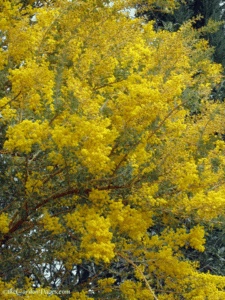
Acacia in bloom.

     As a child, trees in our vicinity were a particular draw. It was not a exceptionally wooded landscape. There was the feeling of cultivated lands slowly being returned to their original inclinations: verdant. I would wander as far from the house as I was allowed and stand among young acacias. Their smooth grey trunks and yellow springtime fluff gave off a feeling that I cannot express even today. Their trunks were about 5 inches in diameter, I believe, and they would sway in the breeze, creating a small gap at their base as they shifted back and forth. I was small, they were tall. We had a relationship.

There were other trees I grew to know over time, but these were my first loves. I do realize I was an odd child; lonely, small, hungry and silent. Odd has turned out to not be such a bad thing. Apparently there are also the odd moments of grace in life that hardly make sense in the world of ordinary concepts.

     The following story speaks for itself. As an aside, the name ‘Culley’ is Gaelic in origin, meaning ‘the woods’.

What May Enter Here

Part One

     Culley had been standing in the grove for some time now, standing still. His mother could see him from the back door of the house, the land rising gradually from there and cresting with the stand of acacia trees just coming into bloom. She paused her process of baking bread every so often to check and see if he had moved. Her wristwatch had stopped yesterday and she had left it on the counter of her bathroom this morning. She made a snorting sound of frustration as she automatically checked her naked wrist one more time.

      Culley’s mother slid the two loaves into the oven, checked the time on the clock in the other room, and pulled on her sweater and wellies. She tried hard not to run or to slip on the still damp spring grass. When she had nearly reached the grove, she approached more slowly: moving a step or two and then pausing to watch her child, who was far too fey for his own good. At last she came to stand by him, nearly brushing against his shoulder, carefully watching, still. At last he looked up with a sunny smile.

     “Hello, my child. What are you doing?” her words as softly spoken as she could make them.

     “I’m talking to the trees, Mama.”

     Culley’s mother unconsciously pressed her fist up to her mouth, a look of anxiety walking shamelessly across her face. Culley had turned back to the trees, rapt.

     “Do they answer you, my sweet boy?”

     “Yes, but they are very slow.” He did not look away from the grove as he spoke. Culley’s mother pressed her fist against her head this time. A movement, caught in the corner of her eye, caused her to jerk her head in that direction. Her son cast her another smiling look, as if waiting to share her excited recognition of something. This time she schooled her face to stillness. Culley turned back to the grove.

     “You’ve been here for a long time. It’s time for you to come home and help with dinner.”

     “OK, mama!” He seemed completely unperturbed, and his mother slid her hand into his and turned him toward home. Another movement beneath the trees turned her still face to stone and she deliberately turned her back to it. At the kitchen door, Culley pulled back and let his mother remove her boots before helping him pull his off as well. She stepped inside, then turned to see him pause on the doormat. A shadow of something passed behind his feet. She looked at him as sternly as she was able, an effort on any day.

     “You know the rules, young man!”

     “Yes Mama,” he spoke solemnly, “house things in the house, garden things in the garden, and wild things where they belong.”

     “Very good, now make sure that’s true before you step over our threshold.” She emphasized the ‘our’ only a little and not for his sake, but for the sake those who might need reminding.

     Dinner was constructed from steps; meat cut into cubes and seared, onions browned, root vegetables peeled and chopped. Culley was remarkably skillful with a knife, but she had been forced to purchase the new ceramic ones. He cried when she used the steel ones and refused to touch them himself. She had donated them to a surprised neighbor; saying ceramic was safer for children. She took the bread from the oven just in time, by smell. It seemed she had forgotten to wind up the clock in the sitting room. As the bread cooled on a wooden rack, she sent Culley into the dinning room to draw while the stew cooked.

    Twilight was falling and Culley’s mother opened the back door again, stepping out of her hot kitchen, this time without her sweater. She gazed up the hill with a silent stillness her son would have understood. A late honeybee lit on her flowered blouse, near the elbow. She turned her attention to it. There was nothing to fear in bees, they meant you no harm. Bees were conscientious and diligent, sometimes a bit pompous, but never unkind. If you had something that needed telling, they were here to listen with polite concern.

     “I don’t need to talk about him today, thank you. It’s his son I worry for. I don’t think you can help me there.” She smiled with a touch of sad chagrin. The bee hummed for a moment longer on her arm and took flight to a home where his yellow dust was a badge of courageous enterprise. She thought of the budding acacia and wondered just how much the bees had seen.

     Dinner did not begin until full dark had fallen. This was not due to a plan of any sort; it was the tenderness of potatoes for the most part, that dictated the time. When Culley had eaten his last bite, he set the spoon to the side with authority; a small clink that gave his mother warning. She waited, toying with the last bit of her bread.

     “Mama, will I go to school next year?”

     “I think you will be old enough.”

     “Papa’s family say I should come to them for school.”

     “Do they now.” Her tone was flat, her face resolved to this bitter news. “When did you begin to talk with them?”

     “After the trees. They are all friends.”

     “Yes.”

     “They say that Papa would have wanted me to learn from them. I know you don’t like them.”

     At this she looked up at her son’s face in surprise. “Not true. Your father was one of them and I have never stopped loving him.”

     Culley tilted his small head like a bird listening for something. “Then why have you closed our door to them?”

     His mother nodded in acceptance. This was a conversation she knew would someday arrive. Very softly she said, “Their interference was what led to his death.”

     “But they did not mean to, they told me that they miss him too.”

     “I have no doubt they miss him, but he was mine and they had no right here.”

     An uncommon look of concern took up residence in her son’s face. With a deep sigh she straitened her shoulders and spoke. “Let the red fox come, the one they hail as Todd, and we will parley.” 

     With such a solemn demeanor did her son bow his agreement, for all the world as might the lord of the hall agreeing on terms. She felt the gurgle of a laugh even through her sadness, which she immediately suppressed. Both here and in that other place he might be, one day, lord indeed. She must play her part as well, and unflinchingly, if she were to protect her child from the harsh and loving ministrations of a world beyond her ken.

Opening View

Meandering. Stillness and silence lead me, waiting for something to open. During mediation all sorts of things open into my mind, then float away leaving me with a sense of insights having passed through me and moved on. 

Much interconnectedness, for me, is the arising of serendipity within my experiences. Not mere accidents, to my mind, but a clarity of thought that culminates in allowing me to see more precisely how the world relates, one item to another and another, guiding me to a larger perspective. Among the books I am presently reading (and re-reading) is “The Dream of the Earth” by Thomas Berry. He charmingly dedicates this book “To the Great Red Oak, beneath whose sheltering branches this book was written”. 

In his introduction, he begins with:

“One of the most remarkable achievements of the twentieth century is our ability to tell the story of the universe from empirical observation and with amazing insight into the sequence of transformations that has brought into being the earth, the living world, and the human community.”

Thomas Berry


 I must acknowledge that all understanding is developed from empirical observation. From there I am forced to consider how crude our human instruments for observation still are, for all our microscopes, our scanning and calculating power, we still spend much of our time uncertain of what we observe and how to interpret it.  Mr. Berry looks deeply into history, the wisdoms found in myth and ancient traditions, as well as the constant dawning of understanding from scientific exploration. From this broad view he asks: what is our responsibility to the earth?

Thomas Berry describes our relationship with earth as having phases similar to those Joseph Campbell describes in his ‘Hero’s Journey’. Humanity must let go of their childhood and move toward their own coming of age, in responsibility for the planet. 

Of course this is indeed a very broad view, one that demands knowledge and understanding well beyond my own. It moves me, I can see the sense in it, the understanding that he conveys, but it leaves me trembling in my own smallness; the tiny thing that hides in the grass. So, I make my great strides with the use of small words; some borrowed, some my own, but only words. Understanding the things that cannot truly be spoken of with the use of words? Yes. How silly.

Virginia Woolf attempts it in this passage from “Time Passes” in “To the Lighthouse”:

“Then indeed peace had come. Messages of peace breathed from the sea to the shore. Never to break its sleep any more, to lull it rather more deeply to rest, and whatever the dreamers dreamt holily, dreamt wisely, to confirm—what else was it murmuring—as Lily Briscoe laid her head on the pillow in the clean still room and heard the sea. Through the open window the voice of the beauty of the world came murmuring, too softly to hear exactly what it said—but what mattered if the meaning were plain?”

According to Ursla Le Guin (lovely Oregonian author of Science fiction and so much more, recently lost to us), when discussing the style of this piece, Woolf is quoted in a letter to a friend:

“Style is a very simple matter; it is all rhythm. Once you get that, you can’t use the wrong words. But on the other hand here am I sitting after half the morning, crammed with ideas, and visions, and so on, and can’t dislodge them, for lack of the right rhythm. Now this is very profound, what rhythm is, and goes far deeper than words. A sight, an emotion, creates this wave in the mind, long before it makes words to fit it.”

Virginia Woolf
in: Le Guin, Ursula  K. Steering the Craft: A Twenty-First-Century Guide to Sailing the Sea of Story (p. 32). Houghton Mifflin Harcourt.

Words may flicker through you and convey ‘the voice of the beauty of the world’. Ordinary magic, but magic, to be sure.

Real world, eyes open.

What do you see here? This was a remarkable happening, caught on camera at the end of a hike last summer. I still feel a Kaleidoscope of emotions when I look at this scene of beauty and sorrow. I feel conflicting things: a beautiful flower, a beautiful spider, duplicity, fear, death, dinner, survival.

I am not so simple as to think that any word I share here will change this world; result of limitless causes. Still, I imagine that a change of perspective results in a change of intention. My intention has no more power than of a puff of breath into the gale, yet it remains one of the causes. I long to read words that bring me greater clarity, greater depth, and hope. I long to share such words. That is all.

The Landscape of Forest

Welcome to this place.

I hope that my voice will provide you with a gateway into the forest.

“Writing in landscapes, landscapes write in you.”

– Joan Halifax, The Fruitful Darkness

Some Years ago, while visiting Nepal, I had the good fortune to listen to the words of a Nepalese Archeologist. We were standing in front of an excavation in Lumbini, said to be the birthplace of Buddha. There the mother of Buddha was said to have given birth while holding onto the Sal tree. As he continued to speak, he referenced several other trees in the story of Buddha, and then paused to make an aside:

“It makes you wonder, really, if this is not actually all about the trees.”

He laughed and continued his discourse, but the words stayed with me as softly spoken ideas sometimes do. I remembered the impact of trees in my life and the subtle flavor of places, of landscapes that have moved me. Today, I have given a certain credence to this sensation and have concluded that whether it is a lower brain response to a safe and healthy landscape, or a higher brain desire for beauty, trees do hold a significant place in my relation to earth.

The expression of such things is understandably elusive. All aspects of our interconectedness can seem a challenge, at times, to express. We recognize them in flashes in our consciousness and then turn away to resume what we believe to be the important work of our lives. I have often felt helpless to express such thoughts on the world I have witnessed, in Europe, North America, Africa, Asia, and the Middle East. Sometimes the human pain I saw, due to economic imbalances, or the compassionate sorrow that twisted my gut, when disrupted landscapes destroyed or displaced plants and animals, became unbearable.

I would try to speak of my experiences with friends and acquaintances, but such topics seem to slide away from peoples interest focus. Their eyes typically glaze and they make a perfunctory remark, returning to the issues they know, relegating your experience to some other world beyond their ken.

This apparent disinterest was a tipping point for me, one day. I identified with a world much larger than the one my associates knew. I also felt compassion, hope, and fear for that world. I began to wake in the night, while living in Africa, and tell myself fictional stories of people who saw and solved the worlds issues. I set aside two decades of filtered ramblings in a journal and opened up into poetry, fantasy, and science fiction. It was personal and it was private. It was also a healing place. This is what I hope to share in these pages.

Fallen Leaves, Fallen Trees

Words fall away from my mind in orange and yellow
They litter the ground, leaving me silent
The flavor of it sits in my mouth
Bitter or sweet
A nameless perfume rife with memory
 
I am at last
Finally, That Tree
Tall, still, I brace the landscape
My leaves fallen about me as past glories to dissolve
Food for saplings
 
I am that tree
Shading the heads of pilgrims
I stand as safe roost for eons of flocks
Soundless, I shrug a shoulder 
Or fan my hands
 
I am post and lintel
Cup, bowl, canoe
I am fire hardened spear and arrow; slit for the stone
Cradle, coffin, crucifix
I take the hangman’s name in silence
 
I am that tree.
Support for Maya in her birth throws
Canopy for her son as he awoke
Gathering place for the elders
The sentinel in silence forgotten
 
Standing within the cycle eternal
Fully aware and in silence
I am falling, falling
My essence dreams
And wakes again

Kiora Tash
2012