Sacred Journey of the Tree

Sacred Journey of the Tree

“These Things are One. They are Unity. They are Ourselves.”

These are the words of Ramon Medina Silva: The Mara’akame of the Huichol people of Mexico. He describes seeing the world reflected in ourselves. Seeing ourselves in all things; the collective dream.

The landscapes of dream are often where my clearest images erupt; transforming, healing, and integrating what has lain on the surface of my conscious mind, too thinly scraped to call attention. This realm is a place of understanding that is so very difficult to form into words. Sometimes I wonder if the Earth may be dreaming us in her attempt to understand. May she understand.

In Joan Halifax’s book ‘The Fruitful Darkness’, she shares her own understanding of the Huichol people:

“The myth of the journey to Wirikuta is at once a sacred journey and a collective dream. The history recounts how the Ancient Ones, the gods of the Huichols, fell ill through forgetting, yet, returning to the traditional ways, were healed. The myth is also a collective dream reminding the people of the value of the continuity of traditions, particularly as they apply to place, to sacred and real locales.”

So far removed am I from my traditions in the waking world, that when they call my name in the dairy isle of the market, I hear only the blare of music and read those mythic labels with dulled uncomprehending eyes.

The wonder and the mystery are so easily lost.

Carroll Cloar 1913-1993

So for the moment I will try to share that wonder, beneath the tree. I may be stricken, I may be wounded, but I still do dream. Small impoverished dreams perhaps, but even the smallest thing has its place in the grandeur.

Tree-friend

Part Six: What May Enter Here

Culley sat waiting for his grandmother’s attention, cross-legged before the fire in her private rooms. He did not mind. Time between both worlds moved for Culley in a way that neither world seemed to notice. He would have been hard pressed to put it into words, had anyone asked. No one did. 

     He had noticed a shift in his mother after the thing that had happened to her. It was as if she were more still, rather than different. Her tone and her manor had not changed much, but the time between her words seemed to rest within a plane of its own. She now seemed, to Culley, to be nearer kin to the trees than to their surrounding human neighbors. He did not find this to be a bad thing, having been friends with the trees for a very long time, but any change in ones own mother seems to be a cause for deeper attention if only to reassess that all is still well.

     Todd had become, if anything, a more vigilant and now insistent caretaker since that happening. He was soft spoken and humorous as always, but his word brooked no gainsaying when it came to the issues of safety. This had forced Todd to travel more openly in the world of man, since he would not leave Culley’s Mama to travel alone. At first Culley had been stunned to see such an unflinchingly courageous fellow change color and twitch when riding in the auto to the market, but Todd quickly adapted and even attempted to operate the hulking ancient Citroën his mother had kept from her fathers estate, long before Culley was even born. Considering the normal self-adjustment that takes place when a Citroën is ignited: a rising and shifting due to the hydro-pneumatic forces, which gives the impression of sentience, this was an act of true bravery. 

     Todd was only allowed to cruise the small road that bordered the fence of their property in the end. Culley’s Mama had to explain licensing requirements, and identification issues, to Todd in great detail, again and again, and how they prevented him from traveling farther afield. Todd seemed to think that there must be some sort of loophole that would allow an unremarkable fey fellow to trundle down the roads of man-kind. She eventually came close to losing her temper.

     “You are not The Doctor waving psychic paper!”

     “Sorry, what Ella? Not Who?”

     Culley knew exactly what she meant and smiled ear to ear to hear Todd step unerringly into the ‘who’ joke. Season’s 1 and 2 of ‘Doctor Who’ were the only DVD’s that his mother had ever owned. The tiny flat screen TV, and the DVD player, along with the two best seasons, were a gift from a college friend from long ago; before she had met Culley’s father. The entire device lived beneath a colorful Costa Rican tapestry and Todd had thought it was an art installation; so much of the house was scattered with such things. Culley took him by the hand, sat him down, pulled the cover off with a magicians flair, and then pluged the device into an electrical socket. Todd was delighted.

     “You have never seen a movie?”

     “I had heard rumors, but who would believe such a thing existed.” Todd leaned into the picture so as to catch every word, while Culley watched him with a smile. Ella was talking softly to the groceries in the kitchen. Since she always had done this, neither of them paid much attention.

     “Most of the neighbors have something like this. I think it is too noisy though.” Culley informed him.

     Todd cast him a worried glance. “Where does this man live? Is such magic common place, if so many have seen these things?”

     “Only the magic of the machine. This is merely a Bard’s tale, captured by the machine. Such magic is long gone from man’s world, if it ever were here at all.”

     “But the machine itself is magic, so why not the magic it portrays?”

     Culley paused, feeling an unusual sense of frustration. “Todd?” He tried at last. “When you encounter a sense a magic in yourself, can you say where it grew from?”

     “No, not truly. I can remember the things that led to my knowing, but not the true path itself.” Todd was intensely curious about this and had pushed the system’s ‘off’ button on the block that Culley had shown him would control the device. “In other words, it seems unexplainable: true now, but hidden before,” he added.

     Culley nodded, still unsure of what he could explain. “When a human understands something in mans ‘science’ or ‘magic’, and sees how it works, he might feel the same way as you; shifting from not-knowing to knowing. However, he captures each part of the process, so that he can hand it to another human, sharing it with them as a practice of opening. He understands the physical properties of this world so well that he can teach their use, by repeating the process in tiny events, each entirely under his control.

     “So, there is no mystery?”

     “There is always a mystery. In Fey the mystery is held differently. Most men fail to hear it, or smell it, because the other ways they ‘know’ are not only very loud, but considered proper. To use the methods normal to Fey is considered either weak or perhaps mad.”

     Todd seemed to consider this deeply, silence resting with him for some moments, then he slide the remote over to Culley with a sheepish smile. “I believe I will help your mother prepare the dinner.”

      That had been last night. Culley still felt some sense of guilt. He had destroyed Todd’s wonder with simple unadorned facts. Even now he was not completely sure that he understood the whole of it. After all, his own knowledge of science came only from books, not experience. Behind him, he heard his grandmother rustle her papers and cork her inkwell. She now cleared her throat; a long standing sign between them that he would be given attention now. Culley smiled to the fire and stood, turning to face his Queen and kin.

     “Good evening Grandmother, are you well?”

     “Yes, child. As well as might be at my age.” She winked at him and he smiled back, meeting her eyes for a moment. “What is it you wish to speak to me about?”

     “I wonder if I might stay here in your home for some time to come?”

     She crinkled her brow and spread her hands in inquiry, but held her peace.

     “I have work to do of a nature that must be constantly attended to.” Culley looked down to gather his thoughts. “I believe it will benefit from the air of Fey.”

     His grandmother nodded slowly and thoughtfully. “I will inform the household. Will your mother be pleased with your choice?”

     Culley barely moved a shoulder in answer. “I will speak with her soon. She has always been my support.” Then he paused in a way that held his very heart in check for a moment before going on. “May you and I speak with ease in this room?”

     She watched him with the same still care. “Yes.” she answered softly, none the less, and then turned to close the door. She indicated the chairs by the fire and lifted a cordial in its cut crystal decanter from the table set between, filling one glass, then after a pause, filling the other by half as well.

     Culley smiled and tilted his head as he watched her. She returned the gesture as she handed him the full glass and seated herself to listen, taking a small sip. Culley also took a sip and set the glass aside as he curled his legs up onto the chair beneath him.

     “Who are they Grandmother? I need to know.”

She looked seriously at him for a few moments, with a thoughtful frown. “I suppose you are planning to tell the trees?”

Culley lifted a shoulder a fraction, in answer, as his grandfather was wont to do now and then.

Much later, as the queen still sat, eyes resting on the fire, but not seeing its flicker, a rap on the door brought her back into the room.

     “Enter!” she called a bit shortly, feeling startled and not liking it.

     “Only me, my dear.” Her consort stood leaned with one arm against the carved wooden frame, his stick thrust under the other arm, un-needed. He tilted his head and looked so much the rascal, that it forced a laugh from her. “Dinner?” he asked, the epitome of casual disinterest.

     “Have I kept you waiting?” Her eyes twinkled.

     “Only this last hour. Your cook is displeased, I am merely curious.”

     “Come in and shut the door. I have been talking with Culley.”

     “You are concerned?” He asked this with a sudden serious turn of attitude.

     “Not so much concerned as thoughtful, but yes, there may be cause for concern eventually. He is so much like his father.” Dain’s own father walked to the other chair and sat down facing her.

     “What has he discussed with you?” He was brisk and serious.

     “He wants to know who our enemy is and why.”

     “You have told him?”
     “What I have told is true.” She looked down, the glass still in her hand catching firelight. Her face folded in anxiety as she spoke.

     “What you must tell is all. He will suffer if he does not fully understand.”

     “What do any of us understand?”

     “Do not equivocate, my darling. We made a mistake in not fully warning Dain, in waiting. You must be blunt and clear.”

      “You are right,” sorrow and worry flooded her eyes. “I will speak with him when he returns.”

     Her heart’s love stood and bent to kiss her lips tenderly, before guiding her to dinner.

THE WILD AND SHAPELESS AIR

Mary Oliver (the 1984 winner of the Pulitzer Prize for Poetry) wrote a poem about Stanley Kunitz (named United States Poet Laureate in 2000).

I would like to share it with you.

Stanley Kunitz 

by Mary Oliver

I used to imagine him
coming from his house, like Merlin
strolling with important gestures
through the garden
where everything grows so thickly, 
where birds sing, little snakes lie
on the boughs, thinking of nothing
but their own good lives, 
where petals float upward, 
their colors exploding, 
and trees open their moist
pages of thunder –
it has happened every summer for years.

But now I know more
about the great wheel of growth, 
and decay, and rebirth, 
and know my vision for a falsehood.
Now I see him coming from the house –
I see him on his knees, 
cutting away the diseased, the superfluous, 
coaxing the new, 
knowing that the hour of fulfillment
is buried in years of patience –
yet willing to labor like that
on the mortal wheel.

Oh, what good it does the heart
to know it isn’t magic! 
Like the human child I am
I rush to imitate –
I watch him as he bends
among the leaves and vines
to hook some weed or other; 
I think of him there
raking and trimming, stirring up
those sheets of fire
between the smothering weights of earth, 
the wild and shapeless air. 

Of his own work, Kunitz said:

“The poem comes in the form of a blessing—like rapture breaking on the mind.”

Kunitz was also remarkable for his courageous stance as a conscientious objector.

I read Mary Oliver’s take on him: 

“Knowing that the hour of fulfillment
is buried in years of patience –
yet willing to labor like that
on the mortal wheel.”

And I knew in that moment, that my own uncertain struggles: 

attempting to understand the whole of life, and my childish practice of wishing it well, 

may in time have its own fruition.

Without excuse I fell down Alice’s rabbit hole. Neither she nor her friends were there. 

I was frightened.

I am not entirely sure where this all began last week, but I have a feeling that the words of Goethe were a trigger. In the title page of the book I was reading, (Centering in Pottery, Poetry, and the Person by Mary C. Richards), were his words:

“Then only are we really thinking

 when the subject on which we are thinking

 can not be thought out.” Goethe

This is a wonderful description of the Zen Koan: a tool intended to bring the mind to its knees, and crack it open, changing its position of perception, its perspective. According to the Zen based teacher, Adyashanti, enlightenment is only that: a change in perspective. He explains that nothing else changes, only how you perceive the world. 

I was pleased with dear Goethe, but set him aside for later.

Then I chanced to read about the author Alyc Helms, while shamelessly wandering through the Internet as I looked for possible literary agents. She caught me with a fox (and I do love the fox), by listing her literary interests as: (not in this order)

  • Foxes 
  •  Gender Identity
  • Liminality – the transitional period or phase of a rite of passage, during which the participant lacks social status or rank, remains anonymous, shows obedience and humility, and follows prescribed forms.
  • Critical theory fanfic – ?

Fanfic (Fan fiction) is the fractal spreading of a story as it erupts from its fans. In other words, the fans cannot get enough, so they write it themselves.

Critical Theory is “a philosophical approach to culture, and especially to literature, that seeks to confront the social, historical, and ideological forces and structures that produce and constrain it. The term is applied particularly to the work of the Frankfurt School.”

The Frankfurt School is at Goethe University. 

(Ah, there is his dear name, who was he, this Goethe-name of inner sanctums, of stone foundations, and library walls?) I haphazardly went to look at the Frankfurt School and found there many names (Kant, Freud, Marx, and other well known European fathers, all vetted and true). 

I was already in the rabbit hole, too far down to see the sky, as this slurry of dense information spilled down on me, slick and sweet as honey. 

“I need to understand all of this!” This thought arose, even while I was convinced, at the same moment, that I would soon be overwhelmed and buried. I was so overwhelmed with the extent of my flagrant ignorance of the truth, that I turned the page and began to read immediately about Kant and Transcendental Idealism:

“The doctrine is most commonly presented as the idea that time and space are just human perceptions; they are not necessarily real concepts, just a medium through which humans internalize the universe.”

Ah! Time and space! I am simply quantumly entangled with Schrodinger’s cat, right?

(Oh god, don’t let me drown.) (Remember to not ever open the box. Remember Pandora!)

This is where it ends. I am not playing cats cradle with Indra’s Net. I am a child with a kaleidoscope who thinks she can un-fracture the world with it.

The world remains fractured.

Whatever emphatic grain has caught in my teeth, I cannot shift it, I cannot spit it out. I must soften it. I move to images made of ink, film, clay and canvas. I rest in them. I must rest.

The child’s brush is blunt; its bristles are splayed from contact with dry paint cakes. 

Yellow, blue, green find the paper randomly. 

More often face and arms are marked with the shaman’s magic.

The pan of water tips and shaman swims. 

Swimming through the trees: great kelp forests. 

Feeding on swaying kelp, sweet, salty: shaman knows an umami delight in life. 

Shaman is swallowed by the Great Fish. 

Water flows, fish ends, shaman becomes cloud. 

Cloud becomes tree.

Tree becomes paper and brush in the child’s hand.

Moss seen in Northern England on an Autumn Day

Gentle Thief

(Part Three of “What May Enter Here”)

I sat upon my haunches in the early morning light. There was no need for me to be here. The boy knew full well his way and the way was short. No, it was not responsibility that drew me nigh, and not the boy I watched for. For a creature like myself, curiosity is the greatest flaw.

     The lights came on in the small clapboard house and I stood leisurely, stretched, and trotted off to the nearby enclosing clump of trees. There, I lay down, chin resting on paws, so that I might watch unseen beneath the leafy boughs, which nearly brushed the ground. It was a fair day and eventually all the curtains were opened in the house, presumably to let the sunlight in. I knew the woman’s habits well and watched with a unsettling delight as she moved from room to room, ending up in the kitchen, moving deliberately, moving with an economy of effort, while keeping her carriage tall. 

     I tried to see her beauty, but was unsure of what I saw. Dain had loved her enough to risk everything he had been raised for, and I had most certainly loved Dain, my only friend. I wondered what the flavor or scent of this human woman had been to capture the heart of a Fey man, but Dain had never been ordinary, had he? Fey or not, he had bent every rule made; becoming friends with one such as I, had been only one of them.

    Culley left at his appointed hour, carrying a lunch and shifting a rucksack over one shoulder as he turned to wave to his mother. I held still as a stalled breeze, as he passed, but Culley spoke “Good Morning Todd” softly with a smile, while seeming to look straight ahead. I smiled back, my red tongue escaping for a moment. I found it easy to be myself around him. The boy was defiantly Dain’s child in so many ways. I had met Dain at about this age. He was the first child of any kind I had met, my adoptive mother having rightly judged my safety to outweigh social interaction.

     Mora was already old when she found me, late in the night, mewling and whimpering in the back of a blood soaked den. Herself a victim of Fey power maneuvers, she guessed my plight and hid me away until she deemed it safe. Neither she nor I have ever gleaned the truth, even Dain’s endeavors in the lofty world of his family led to nothing. My mother was killed by an arrow; the other kits were easily dispatched with something blunter. I have no strong memory of it, only a time of terror and hunger ended in Mora’s arms. She gave me food and a bed and in the morning left to bury my family.  I did not see the arrow she had preserved until I was 16 and she told my story to both me and Dain.

     My kind have no name, I have met no other like me, nor had Mora. The word “Todd” simply describes “fox”, which Mora called me in the years before my first transformation at age 4 or 5. My bipedal form holds no name, nor do the other forms I may possess but which have not yet arisen for me. I still live with Mora, but since Dain’s passing I trust no other. I am now well known for my skills in parlay, I am held in trust by the highest in that land, but that trust is not returned, for I must believe one of them ended my family. I watch their eyes and I wait.

     Today is a different sort of inquiry. I give Ella another hour before I rise to announce myself. Trousers and shirt are stored in the feed cupboard by the chicken coop, by previous agreement. The hens have grown used to me, which I find irritating. One day I may reeducate them about this fox. I smack my jaws wetly, snuff the air, and fantasize choosing the brown one. Strange to raise them only for eggs: a waste. The clothing is soft; the trouser seams are bound down on the inside, so they will not rub. She chose this for me when I tried to wear Dain’s hard blue pants the other way out: its seams were unbearable! Ella says I am wearing clothing made to sleep in. I asked her why anyone would sleep in clothing and caused her to blush. I am as rough and graceless as a stable boy in this world, at times. We have both learned to laugh at our shared ignorance. Laughter heals, a truly universal magic.

     I press the button, which rings a bell. I delight in such things, still appalled at the easy magic these creatures have mastered.

     “Todd!” Is she pleased, surprised, or unhappy? I cannot decide. “Come in. I was planning to work today. Would you like to have tea in my studio?”

     “I have always wondered about the art you make, Ella. Thank you”, sometimes I am too blunt, but she seems unfazed by my expressed interest, which I judged to be remarkably rude as it left my mouth. Her smile seems genuine. I pretend I am Dain for an instant, to understand what called him to her. Immediately I falter, it seems too offensive. I am ashamed and silently ask Dain’s forgiveness before entering. I have no shoes to shed at the door, but I wipe my feet and she waves me into her inner sanctum.

  “Go ahead and look around, I will fetch the tea things.”

     I cannot even respond. It is by far the largest room in the house, with the roof as high as the second story. It appears to have been built on at a later time. The windows are notably different; large and unframed. Daylight sparkles across the room and brilliantly lights the paintings, and other stranger things hung on every wall. Canvass and oil I understand, but natural wood melded with glass or metal to create lifelike forms, is beyond me. She finds me slumped in a padded chair, my head back, my mouth open, as if I had been tippling.

     “I had no idea. Dain never said. Is it done with magic?”

     She placed the tea and food on the table while trying to control her face. She did not want to laugh at me.

     “Your complements are far too much for my simple work. I thank you,” was her controlled answer.

     She sounded so diplomatic and proper that I burst out laughing myself and she joined in. “Truly, I have never seen art of such shocking beauty and intriguing concept. Perhaps I sound like a fool in your world, but I am not given to flattery. Have you noticed?” I ended with this, in an attempt to disarm her and return to some sort of more natural conversation. It worked, but I was still over awed by the plethora of creation around me. We poured tea and I asked her to take me piece by piece through her work. It took over two hours. It was marvelous.

     At last we sat, the teapot empty, and I had no more contrivances that might allow me to linger. The day was passing and I could feel her desire to return to the work that was her livelihood.

     “Thank you Ella,” I spoke simply as this was all I had. Her responding smile was radiant. I could hardly look at her. She cast no glamors; that I might have fought. It was in her pure unsullied honesty that I might drown. In horror I knew this is what it had been.

She and Dain had actually fallen in love.

Beyond Our Ken

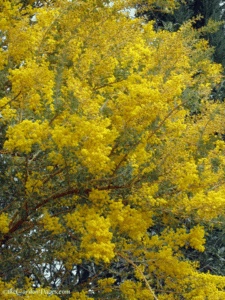
Acacia in bloom.

     As a child, trees in our vicinity were a particular draw. It was not a exceptionally wooded landscape. There was the feeling of cultivated lands slowly being returned to their original inclinations: verdant. I would wander as far from the house as I was allowed and stand among young acacias. Their smooth grey trunks and yellow springtime fluff gave off a feeling that I cannot express even today. Their trunks were about 5 inches in diameter, I believe, and they would sway in the breeze, creating a small gap at their base as they shifted back and forth. I was small, they were tall. We had a relationship.

There were other trees I grew to know over time, but these were my first loves. I do realize I was an odd child; lonely, small, hungry and silent. Odd has turned out to not be such a bad thing. Apparently there are also the odd moments of grace in life that hardly make sense in the world of ordinary concepts.

     The following story speaks for itself. As an aside, the name ‘Culley’ is Gaelic in origin, meaning ‘the woods’.

What May Enter Here

Part One

     Culley had been standing in the grove for some time now, standing still. His mother could see him from the back door of the house, the land rising gradually from there and cresting with the stand of acacia trees just coming into bloom. She paused her process of baking bread every so often to check and see if he had moved. Her wristwatch had stopped yesterday and she had left it on the counter of her bathroom this morning. She made a snorting sound of frustration as she automatically checked her naked wrist one more time.

      Culley’s mother slid the two loaves into the oven, checked the time on the clock in the other room, and pulled on her sweater and wellies. She tried hard not to run or to slip on the still damp spring grass. When she had nearly reached the grove, she approached more slowly: moving a step or two and then pausing to watch her child, who was far too fey for his own good. At last she came to stand by him, nearly brushing against his shoulder, carefully watching, still. At last he looked up with a sunny smile.

     “Hello, my child. What are you doing?” her words as softly spoken as she could make them.

     “I’m talking to the trees, Mama.”

     Culley’s mother unconsciously pressed her fist up to her mouth, a look of anxiety walking shamelessly across her face. Culley had turned back to the trees, rapt.

     “Do they answer you, my sweet boy?”

     “Yes, but they are very slow.” He did not look away from the grove as he spoke. Culley’s mother pressed her fist against her head this time. A movement, caught in the corner of her eye, caused her to jerk her head in that direction. Her son cast her another smiling look, as if waiting to share her excited recognition of something. This time she schooled her face to stillness. Culley turned back to the grove.

     “You’ve been here for a long time. It’s time for you to come home and help with dinner.”

     “OK, mama!” He seemed completely unperturbed, and his mother slid her hand into his and turned him toward home. Another movement beneath the trees turned her still face to stone and she deliberately turned her back to it. At the kitchen door, Culley pulled back and let his mother remove her boots before helping him pull his off as well. She stepped inside, then turned to see him pause on the doormat. A shadow of something passed behind his feet. She looked at him as sternly as she was able, an effort on any day.

     “You know the rules, young man!”

     “Yes Mama,” he spoke solemnly, “house things in the house, garden things in the garden, and wild things where they belong.”

     “Very good, now make sure that’s true before you step over our threshold.” She emphasized the ‘our’ only a little and not for his sake, but for the sake those who might need reminding.

     Dinner was constructed from steps; meat cut into cubes and seared, onions browned, root vegetables peeled and chopped. Culley was remarkably skillful with a knife, but she had been forced to purchase the new ceramic ones. He cried when she used the steel ones and refused to touch them himself. She had donated them to a surprised neighbor; saying ceramic was safer for children. She took the bread from the oven just in time, by smell. It seemed she had forgotten to wind up the clock in the sitting room. As the bread cooled on a wooden rack, she sent Culley into the dinning room to draw while the stew cooked.

    Twilight was falling and Culley’s mother opened the back door again, stepping out of her hot kitchen, this time without her sweater. She gazed up the hill with a silent stillness her son would have understood. A late honeybee lit on her flowered blouse, near the elbow. She turned her attention to it. There was nothing to fear in bees, they meant you no harm. Bees were conscientious and diligent, sometimes a bit pompous, but never unkind. If you had something that needed telling, they were here to listen with polite concern.

     “I don’t need to talk about him today, thank you. It’s his son I worry for. I don’t think you can help me there.” She smiled with a touch of sad chagrin. The bee hummed for a moment longer on her arm and took flight to a home where his yellow dust was a badge of courageous enterprise. She thought of the budding acacia and wondered just how much the bees had seen.

     Dinner did not begin until full dark had fallen. This was not due to a plan of any sort; it was the tenderness of potatoes for the most part, that dictated the time. When Culley had eaten his last bite, he set the spoon to the side with authority; a small clink that gave his mother warning. She waited, toying with the last bit of her bread.

     “Mama, will I go to school next year?”

     “I think you will be old enough.”

     “Papa’s family say I should come to them for school.”

     “Do they now.” Her tone was flat, her face resolved to this bitter news. “When did you begin to talk with them?”

     “After the trees. They are all friends.”

     “Yes.”

     “They say that Papa would have wanted me to learn from them. I know you don’t like them.”

     At this she looked up at her son’s face in surprise. “Not true. Your father was one of them and I have never stopped loving him.”

     Culley tilted his small head like a bird listening for something. “Then why have you closed our door to them?”

     His mother nodded in acceptance. This was a conversation she knew would someday arrive. Very softly she said, “Their interference was what led to his death.”

     “But they did not mean to, they told me that they miss him too.”

     “I have no doubt they miss him, but he was mine and they had no right here.”

     An uncommon look of concern took up residence in her son’s face. With a deep sigh she straitened her shoulders and spoke. “Let the red fox come, the one they hail as Todd, and we will parley.” 

     With such a solemn demeanor did her son bow his agreement, for all the world as might the lord of the hall agreeing on terms. She felt the gurgle of a laugh even through her sadness, which she immediately suppressed. Both here and in that other place he might be, one day, lord indeed. She must play her part as well, and unflinchingly, if she were to protect her child from the harsh and loving ministrations of a world beyond her ken.

Opening View

Meandering. Stillness and silence lead me, waiting for something to open. During mediation all sorts of things open into my mind, then float away leaving me with a sense of insights having passed through me and moved on. 

Much interconnectedness, for me, is the arising of serendipity within my experiences. Not mere accidents, to my mind, but a clarity of thought that culminates in allowing me to see more precisely how the world relates, one item to another and another, guiding me to a larger perspective. Among the books I am presently reading (and re-reading) is “The Dream of the Earth” by Thomas Berry. He charmingly dedicates this book “To the Great Red Oak, beneath whose sheltering branches this book was written”. 

In his introduction, he begins with:

“One of the most remarkable achievements of the twentieth century is our ability to tell the story of the universe from empirical observation and with amazing insight into the sequence of transformations that has brought into being the earth, the living world, and the human community.”

Thomas Berry


 I must acknowledge that all understanding is developed from empirical observation. From there I am forced to consider how crude our human instruments for observation still are, for all our microscopes, our scanning and calculating power, we still spend much of our time uncertain of what we observe and how to interpret it.  Mr. Berry looks deeply into history, the wisdoms found in myth and ancient traditions, as well as the constant dawning of understanding from scientific exploration. From this broad view he asks: what is our responsibility to the earth?

Thomas Berry describes our relationship with earth as having phases similar to those Joseph Campbell describes in his ‘Hero’s Journey’. Humanity must let go of their childhood and move toward their own coming of age, in responsibility for the planet. 

Of course this is indeed a very broad view, one that demands knowledge and understanding well beyond my own. It moves me, I can see the sense in it, the understanding that he conveys, but it leaves me trembling in my own smallness; the tiny thing that hides in the grass. So, I make my great strides with the use of small words; some borrowed, some my own, but only words. Understanding the things that cannot truly be spoken of with the use of words? Yes. How silly.

Virginia Woolf attempts it in this passage from “Time Passes” in “To the Lighthouse”:

“Then indeed peace had come. Messages of peace breathed from the sea to the shore. Never to break its sleep any more, to lull it rather more deeply to rest, and whatever the dreamers dreamt holily, dreamt wisely, to confirm—what else was it murmuring—as Lily Briscoe laid her head on the pillow in the clean still room and heard the sea. Through the open window the voice of the beauty of the world came murmuring, too softly to hear exactly what it said—but what mattered if the meaning were plain?”

According to Ursla Le Guin (lovely Oregonian author of Science fiction and so much more, recently lost to us), when discussing the style of this piece, Woolf is quoted in a letter to a friend:

“Style is a very simple matter; it is all rhythm. Once you get that, you can’t use the wrong words. But on the other hand here am I sitting after half the morning, crammed with ideas, and visions, and so on, and can’t dislodge them, for lack of the right rhythm. Now this is very profound, what rhythm is, and goes far deeper than words. A sight, an emotion, creates this wave in the mind, long before it makes words to fit it.”

Virginia Woolf
in: Le Guin, Ursula  K. Steering the Craft: A Twenty-First-Century Guide to Sailing the Sea of Story (p. 32). Houghton Mifflin Harcourt.

Words may flicker through you and convey ‘the voice of the beauty of the world’. Ordinary magic, but magic, to be sure.

The Landscape of Forest

Welcome to this place.

I hope that my voice will provide you with a gateway into the forest.

“Writing in landscapes, landscapes write in you.”

– Joan Halifax, The Fruitful Darkness

Some Years ago, while visiting Nepal, I had the good fortune to listen to the words of a Nepalese Archeologist. We were standing in front of an excavation in Lumbini, said to be the birthplace of Buddha. There the mother of Buddha was said to have given birth while holding onto the Sal tree. As he continued to speak, he referenced several other trees in the story of Buddha, and then paused to make an aside:

“It makes you wonder, really, if this is not actually all about the trees.”

He laughed and continued his discourse, but the words stayed with me as softly spoken ideas sometimes do. I remembered the impact of trees in my life and the subtle flavor of places, of landscapes that have moved me. Today, I have given a certain credence to this sensation and have concluded that whether it is a lower brain response to a safe and healthy landscape, or a higher brain desire for beauty, trees do hold a significant place in my relation to earth.

The expression of such things is understandably elusive. All aspects of our interconectedness can seem a challenge, at times, to express. We recognize them in flashes in our consciousness and then turn away to resume what we believe to be the important work of our lives. I have often felt helpless to express such thoughts on the world I have witnessed, in Europe, North America, Africa, Asia, and the Middle East. Sometimes the human pain I saw, due to economic imbalances, or the compassionate sorrow that twisted my gut, when disrupted landscapes destroyed or displaced plants and animals, became unbearable.

I would try to speak of my experiences with friends and acquaintances, but such topics seem to slide away from peoples interest focus. Their eyes typically glaze and they make a perfunctory remark, returning to the issues they know, relegating your experience to some other world beyond their ken.

This apparent disinterest was a tipping point for me, one day. I identified with a world much larger than the one my associates knew. I also felt compassion, hope, and fear for that world. I began to wake in the night, while living in Africa, and tell myself fictional stories of people who saw and solved the worlds issues. I set aside two decades of filtered ramblings in a journal and opened up into poetry, fantasy, and science fiction. It was personal and it was private. It was also a healing place. This is what I hope to share in these pages.

Fallen Leaves, Fallen Trees

Words fall away from my mind in orange and yellow
They litter the ground, leaving me silent
The flavor of it sits in my mouth
Bitter or sweet
A nameless perfume rife with memory
 
I am at last
Finally, That Tree
Tall, still, I brace the landscape
My leaves fallen about me as past glories to dissolve
Food for saplings
 
I am that tree
Shading the heads of pilgrims
I stand as safe roost for eons of flocks
Soundless, I shrug a shoulder 
Or fan my hands
 
I am post and lintel
Cup, bowl, canoe
I am fire hardened spear and arrow; slit for the stone
Cradle, coffin, crucifix
I take the hangman’s name in silence
 
I am that tree.
Support for Maya in her birth throws
Canopy for her son as he awoke
Gathering place for the elders
The sentinel in silence forgotten
 
Standing within the cycle eternal
Fully aware and in silence
I am falling, falling
My essence dreams
And wakes again

Kiora Tash
2012